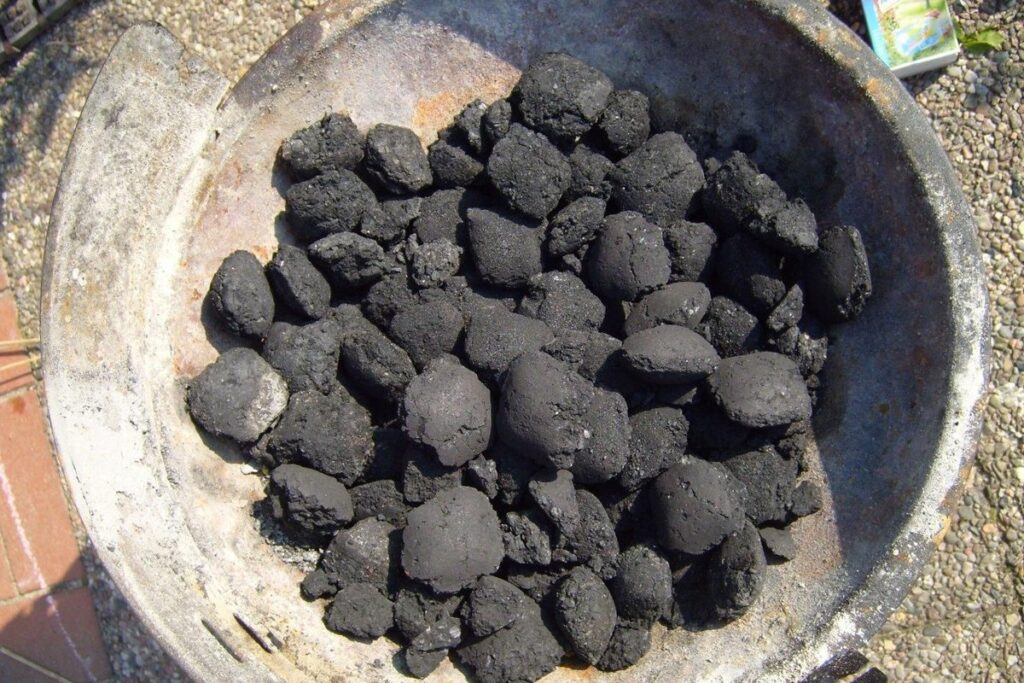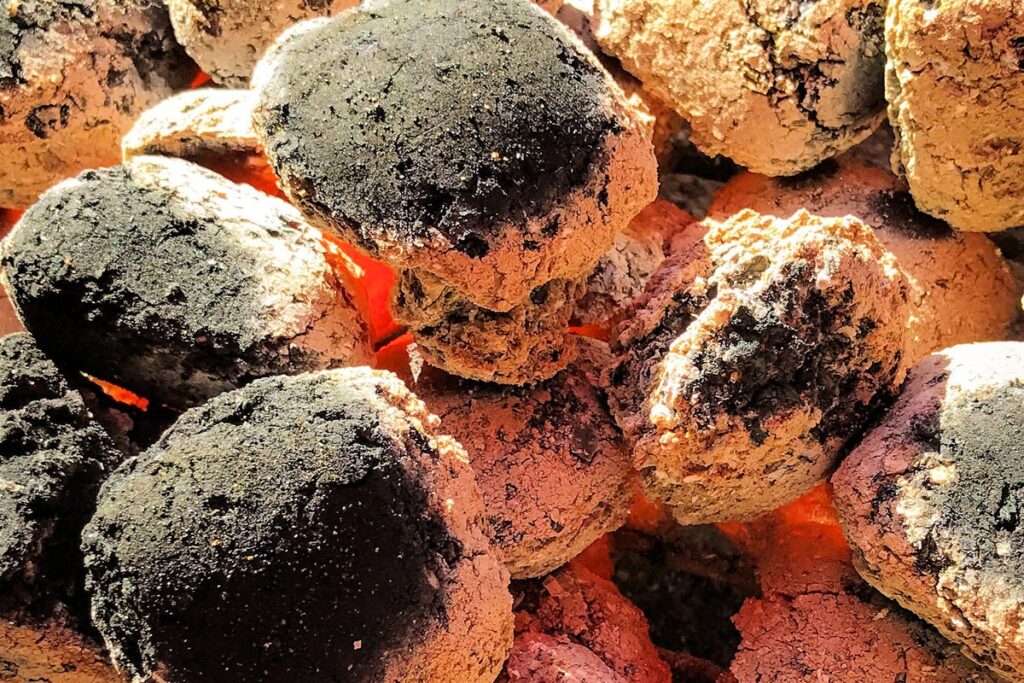
If you are looking for bulk charcoal for sale, you are probably not buying a bag for the weekend. You are filling a container, supplying shops or restaurants, or building a private-label range. At that scale the price per tonne is only part of the decision. What you are really buying is consistency: every carton in the shipment should burn the same way as the sample that convinced you to order.
This guide is written for importers, wholesalers and distributors, mainly in the Middle East and Europe, who are comparing bulk charcoal offers. It covers the main types of charcoal sold in volume, the figures to ask for, the documents that should travel with each shipment, and how to get a quotation you can compare like for like.
What “Bulk Charcoal” Usually Means
In the trade, bulk charcoal is charcoal sold by the container or by the tonne rather than by the retail bag. It reaches buyers in three common forms:
- Loose bulk in large bags. Woven or mesh sacks, sold to distributors who repack locally.
- Master cartons of small inner packs. Ready for retail or catering, often under the buyer’s own brand.
- Private label. The supplier packs to your artwork and specification, so the product reaches the shelf under your name.
Which form suits you depends on where you sit in the chain. A distributor with a packing line may prefer loose bulk; a brand owner usually wants finished retail packs.
Types of Charcoal Sold in Bulk
| Type | What it is | Typical buyers |
|---|---|---|
| Hardwood lump charcoal | Carbonised wood in irregular pieces | Grill shops, restaurants that sear over high heat |
| Coconut shell charcoal briquettes | Carbonised coconut shell, ground, pressed and dried into uniform shapes | BBQ and grill distributors, catering, shisha and hookah brands |
| Coconut shell charcoal (uncompressed) | Carbonised shell before pressing | Briquette makers and industrial users |
Lump charcoal lights fast and runs hot, but its pieces vary in size, so burn behaviour varies from bag to bag. Briquettes are pressed to one shape and density, which gives a more even, predictable burn. That predictability is the main reason many wholesale buyers prefer briquettes for long cooks, catering and shisha. Coconut shell is also a by-product of coconut processing rather than felled timber, a point some buyers include in their sourcing reports. Read more in our guides to grill briquettes and lump charcoal for grilling.
The Figures to Compare Before You Buy
Two offers of bulk charcoal for sale can look identical in a photo and behave very differently in the grill. Ask every supplier to state the same figures for the batch they will ship, and compare them side by side:
- Fixed carbon (%). The share of the fuel that actually burns as charcoal. Higher usually means more heat and a longer burn.
- Calorific value (kcal/kg). How much heat the fuel holds.
- Ash content (%). What is left after burning. High ash chokes airflow and means more cleaning for your customers.
- Moisture (%). Damp charcoal lights slowly, burns unevenly and can lose weight in transit.
- Volatile matter (%). Affects smoke and smell, which matters most for shisha and indoor use.
- Size, shape and burn time. Ask for the dimensions and a burn test on the actual product, not a generic data sheet.
A specification sheet is a promise; a sample is the proof. Before a first container, test samples under your own conditions: lighting time, burn time, ash colour and amount, smell and sparking.
Grading and Particle Size: Comparing Like with Like
Many disputes over bulk charcoal start with size, not chemistry. A container can match the agreed fixed carbon and ash figures and still disappoint, because a large part of the load arrives as small pieces and dust. Size grading is how you prevent that. It is also the area where offers are hardest to compare, because each supplier describes size in its own way.
Lump charcoal and briquettes are graded differently, so treat them separately:
| Product | How size is described | What to fix in the contract |
|---|---|---|
| Hardwood lump charcoal | A size range for the pieces, from the smallest to the largest accepted piece | The accepted range, the share of pieces allowed below the lower limit, and how fines are measured |
| Coconut shell charcoal briquettes | Shape (cube, hexagonal, pillow, finger or flat) and the exact dimensions of one piece | Shape, dimensions with a tolerance, and the share of broken pieces allowed per carton |
| Uncompressed coconut shell charcoal | Mesh or sieve size of the granules, or “as carbonised” pieces | The sieve used, the size band, and the share of dust |
Three terms deserve a clear definition in writing:
- Fines. Dust and small fragments that pass through a sieve of an agreed size. Fines burn poorly, block airflow in a grill and annoy end customers. Agree the sieve, the maximum share of fines per bag or carton, and how the sample for the check is taken.
- Breakage. Briquettes that arrive cracked or in pieces. Some breakage in transit is normal; the question is how much. Agree whether broken pieces count against the weight you pay for.
- Uniformity. How much one piece differs from the next. Uniform pieces light together and burn down together, which is what catering kitchens and shisha lounges pay for.
When you compare offers of bulk charcoal for sale, ask each supplier to send photographs of a sieved sample next to a ruler, plus the size specification written as a range with tolerances. Two quotes for “premium grade” can describe very different products; two quotes with the same size range, fines limit and breakage allowance are much easier to compare. If you sell into the European retail market, it also helps to read the size and fines requirements in EN 1860-2, the European standard for barbecue charcoal and charcoal briquettes, because your customers may already quote it.
Grading also changes the price. Tight size ranges and low fines need more screening at the factory, and the screened-out material has to go somewhere. A supplier who offers a very tight grade at the same price as a loose one is worth questioning before you sign.
Documents That Should Come With Every Shipment
Serious charcoal suppliers expect these requests. If a supplier hesitates, treat it as a warning sign.
- Certificate of Analysis (COA). The batch-specific record of fixed carbon, ash, moisture and calorific value. Ask for past COAs as well as the current one: consistency across batches tells you more than a single good result.
- Material Safety Data Sheet (MSDS). Usually needed by freight forwarders and shipping lines.
- Self-heating test report. Charcoal can heat up in a closed container over a long voyage. Shipping lines often ask for this report before accepting the cargo.
- Certificate of origin and commercial documents. Needed for customs clearance and, in some markets, for preferential duty.
Import rules differ between countries, so check with your customs broker which documents your market requires before you confirm an order.
Packaging and Private Label Options
Packaging decides how the charcoal arrives and how quickly you can sell it. When you ask for a quotation, state:
- the pack you need (loose bulk bags, inner boxes in master cartons, or retail bags);
- whether inner packs need a moisture barrier, which helps on long sea routes;
- whether you need private label printing, and who supplies the artwork;
- labelling language and any marks your market requires.
Packaging also changes how much product fits in a container, so the same price per tonne can mean a different landed cost per pack.
20ft or 40ft? Working Out Container Needs from Bulk Density
Buyers looking for bulk charcoal for sale often ask for “a container” without knowing how much charcoal will actually fit. The answer depends on two limits, and whichever you reach first decides the load: the space inside the container and the maximum weight it may carry.
The figure that links the two is bulk density: the weight of one cubic metre of charcoal as it is actually packed, including the air between the pieces and the packaging. It is not the density of a single briquette. Pressed briquettes stack densely, so a cubic metre of them weighs much more than a cubic metre of irregular lump charcoal, which traps a lot of air. Cartons, inner boxes and pallets add volume and weight of their own.
To estimate your load, collect four figures:
- the bulk density of the packed product, in kilograms per cubic metre, from the supplier (ask for the packed figure, not the density of the raw material);
- the usable internal volume of a 20ft and a 40ft container on your route, from your shipping line or forwarder;
- the maximum payload for each container type, again from the shipping line, and any road weight limits at the destination;
- a stowage factor for the space you cannot use, such as gaps between cartons, pallets and the room needed to close the doors.
Then calculate both limits:
- Weight by volume = usable volume × stowage factor × bulk density.
- Weight by payload = the maximum payload the shipping line and the roads allow.
The smaller of the two is what the container can really carry. If the weight by volume is higher than the payload, the container is weight-limited: it reaches its weight limit before it is full. Dense briquettes in a 20ft container often fall into this group. If the weight by volume is lower, the container is volume-limited: it is full before it is heavy. Light, loose lump charcoal often fills a 40ft by volume first, which is why many lump buyers prefer the larger box.
This simple calculation answers several commercial questions at once. It tells you whether a 40ft container really doubles the quantity of a 20ft one for your product; when the load is weight-limited, it often does not. It shows how packaging choices move the numbers, because small retail packs in master cartons take more space per tonne than large bags. And it lets you compare freight cost per tonne, which is the figure that matters for your landed cost. Ask the supplier for a loading plan for the exact packaging you ordered, and check it against your own estimate before you book the space.
Shipping Terms: FOB or CIF
Bulk charcoal is usually quoted on an Incoterm. The two you will see most often are:
- FOB (Free On Board). The price covers the goods loaded on the vessel at the port of origin. You arrange and pay for sea freight and insurance.
- CIF (Cost, Insurance and Freight). The supplier also pays freight and basic insurance to your destination port.
To compare offers fairly, convert them to the same basis. An FOB price that looks lower may end up higher once freight to Jebel Ali, Rotterdam or Hamburg is added.
Contamination Risks During Sea Freight
Charcoal is a dry, porous product, and a long voyage from Asia to the Gulf or to Northern Europe tests it. Most claims on arrival come from a handful of risks that can be managed before the container is sealed.
- Moisture and condensation. When a container moves between warm and cool climates, moisture in the air condenses on the roof and walls and drips onto the cargo, an effect often called container rain. Charcoal absorbs it, gains weight, lights badly and can grow mould on the cartons. Ask for dry loading, moisture-barrier inner packs on long routes, desiccant bags and, where the route needs it, a liner or kraft paper on the walls and floor.
- Odour and taint. Charcoal picks up smells easily. A container that carried chemicals, fertiliser or strong-smelling goods can pass that smell to the cargo, which is a serious problem for shisha charcoal and food use. Ask the supplier to inspect and record the container condition before loading: clean, dry, odour-free and without holes.
- Foreign matter. Stones, sand, wire or plastic fragments in loose bulk charcoal damage your reputation with end customers. Good screening and packing at the factory are the defence; a pre-shipment inspection by an independent surveyor can check it.
- Breakage and dust. Rough handling and cartons stacked too high crush briquettes into fines. Agree carton strength, maximum stacking height and the use of pallets.
- Self-heating. Charcoal can heat up on its own in a closed container. Under the IMDG Code for dangerous goods by sea, charcoal is listed as UN 1361, Class 4.2, and shipping lines usually ask for a self-heating test report before accepting it. Cargo that has cooled properly after production and passes the test is far less likely to cause problems in transit.
- Pests and wood packaging. If pallets or other wood packaging travel with the cargo, many countries require them to be treated and marked under ISPM 15. Untreated wood can hold up clearance at the destination port.
Write the controls into the purchase contract: container inspection before loading, photographs of the loading at several stages, the packaging specification, and who pays if the cargo arrives wet or contaminated. Cargo insurance on the right terms is the last line of defence, not the first.
Shelf Life in the Importer’s Warehouse
Charcoal does not spoil the way food does. Kept dry and sealed, it keeps its burning qualities for a long time. In practice, the shelf life of bulk charcoal is decided by moisture and by the packaging, not by the charcoal itself. Once moisture gets in, the fuel lights more slowly, smokes more, sparks and gives less heat, and printed retail packs can stain or lose their shape.
A few warehouse habits keep stock in saleable condition:
- Store dry and off the floor. Keep cartons and bags on pallets, away from walls, roof leaks and doors that open in the rain.
- Keep humidity in check. A ventilated store with a stable temperature limits condensation. In humid seasons, check the store more often.
- Rotate by batch. Mark each pallet with the batch code from the Certificate of Analysis and sell first in, first out. Older stock should not be hidden behind new deliveries.
- Re-seal and re-check. Close opened bags, and re-test moisture on stock that has been in the warehouse for a long period, or after a wet spell, before you sell it to demanding customers such as shisha lounges.
- Separate and protect. Store charcoal away from fuels, oxidising chemicals and strong-smelling goods, follow local fire rules, and keep fresh deliveries apart until you are sure they have not warmed up in transit.
When you compare bulk charcoal for sale from different suppliers, ask how the product is packed for long storage, not only for the voyage. A moisture barrier inside the carton and a clear batch code on every pack make stock control far easier. If you plan to hold several months of stock, say so when you request the quote, so that packaging and delivery schedule can be matched to how fast you sell.
How to Request a Quote for Bulk Charcoal
A complete enquiry gets an accurate quotation in one exchange. Send:
- the product and use (BBQ and grill, catering, or shisha);
- shape and size, if you already have a preference;
- packaging and any private label requirements;
- volume per order and how often you plan to order;
- destination port and the Incoterm you prefer.
PT Agro Bumi Sumatera supplies coconut charcoal briquettes from Indonesia to importers, distributors and private-label brands. Product details are on our coconut charcoal briquettes page. If you are still comparing suppliers, our guide for buyers comparing charcoal suppliers in Indonesia explains what to check. Prices are given on request: send your specification and our export team will reply with a quotation.
For a faster reply, message our export team on WhatsApp at +62 812-7444-4459 or email ade@agrobumisumatera.co.id. Our office line is +62 813-6666-888.
Frequently Asked Questions
Is bulk charcoal cheaper than buying by the bag?
Usually yes per kilogram, because packing, handling and freight are spread over a full load. Compare offers on the same Incoterm and packaging before deciding.
Which is better to buy in bulk: lump charcoal or briquettes?
It depends on your customers. Lump suits high-heat searing; briquettes give a more uniform, predictable burn, which suits long cooks, catering and shisha. Many distributors stock both.
What should I check on a charcoal specification sheet?
Fixed carbon, calorific value, ash, moisture, volatile matter and piece size, confirmed on a Certificate of Analysis for the batch you will receive.
Can I order samples before a container?
Ask for samples from the supplier and test them under your own conditions before you commit to a first container.