If you have ever stood over a fire that would not hold temperature, you already know why grill briquettes matter. The fuel you choose decides how often you refuel, how much ash you scrape out and whether a long cook finishes on schedule or stalls at the stall.
This guide covers what grill briquettes are made of, how they compare with lump charcoal and wood, and how to pick the right specification for grilling, smoking and shisha use. Every number below comes from the export specification of our own coconut shell production line in Jambi, Indonesia.
For the full technical sheet and container pricing, see our coconut charcoal briquettes export page.
Daftar Isi
ToggleWhat Are Grill Briquettes?
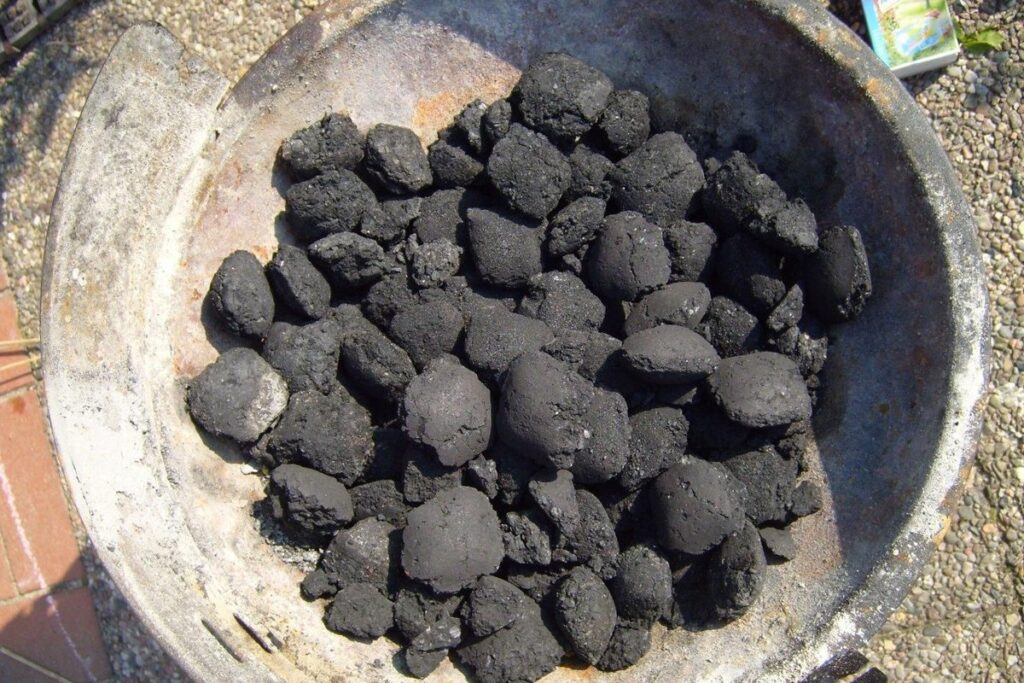
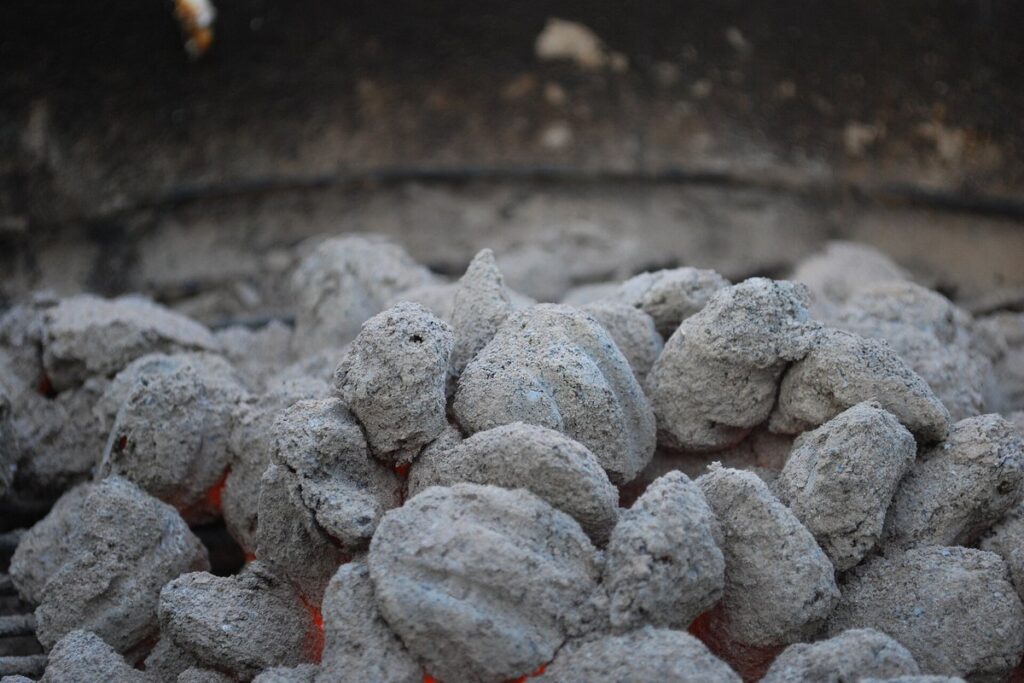
Grill briquettes are a solid cooking fuel made by carbonising biomass and pressing it into a uniform shape. The uniformity is the whole point: a briquette of known size and density burns at a predictable rate, so temperature becomes something you control rather than something you chase.
What separates one grill briquette from another is the raw material and the binder. Cheap briquettes are pressed from sawdust, recycled coal dust and a starch or nitrate binder, which is why they throw heavy ash, spark and smell of chemicals when lit. Coconut shell grill briquettes are pressed from 100% carbonised coconut shell with no coal dust, no sulphur and no nitrate accelerants, so the burn is clean and the ash residue stays under 2.5%.
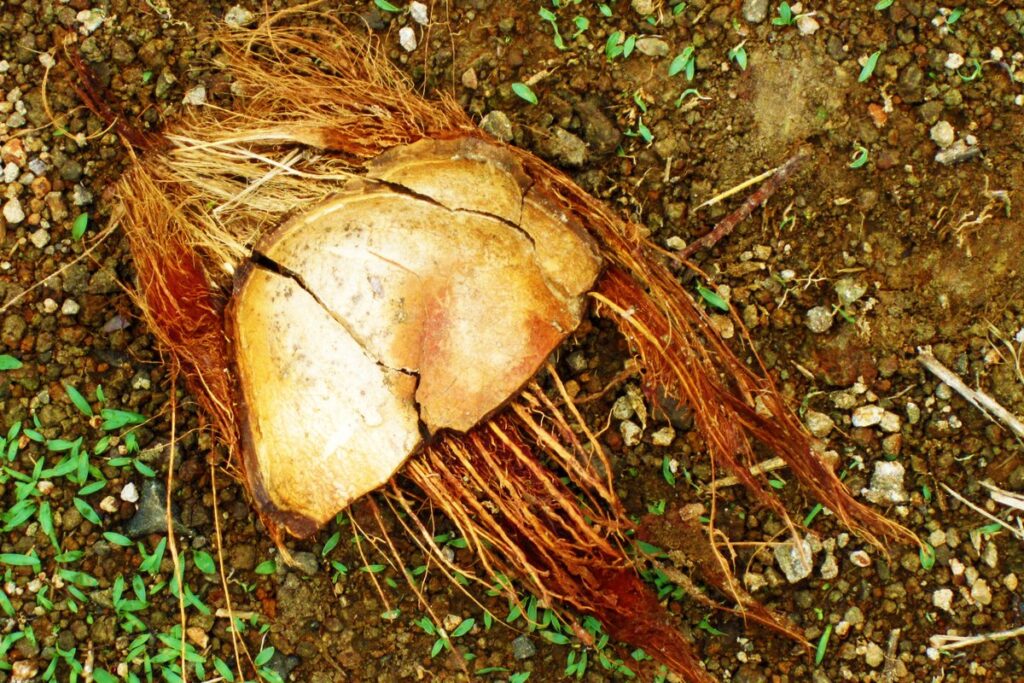
Coconut shell is a by-product of coconut oil production in Sumatra, which means the raw material is dense, consistent and available year round rather than dependent on a single timber harvest.
Grill Briquettes vs Charcoal vs Lump Charcoal
The word charcoal covers everything from cheap supermarket briquettes to premium hardwood lump. The practical differences that affect a cook are burn time, ash volume and how evenly the fuel releases heat.
| Fuel | Burn time per load | Ash | Best for |
|---|---|---|---|
| Coconut shell grill briquettes | 2.5 to 3+ hours | Max 1.8 to 2.5% | Low-and-slow, indirect, shisha, long sessions |
| Wood-based briquettes | 1 to 2 hours | 5 to 8% | Budget volume grilling |
| Lump charcoal | 45 to 60 minutes at high heat | 3 to 6% | Fast sears, hot-and-fast cooks |
| Wood chunks | 45 to 90 minutes as flavour only | Low | Smoke layering, not primary heat |
Lump charcoal lights faster and peaks hotter, which makes it the right tool for a steak seared in ten minutes. Grill briquettes win whenever the cook lasts longer than an hour, because consistent density means consistent heat and far less refuelling.
Most serious cooks end up using both. If you want the detail on where lump wins, read our guide to {L(‘lump-charcoal-for-grilling’,’lump charcoal for grilling’)}.
Burn Time, Heat Output and Ash: The Numbers That Matter
Three specifications decide whether a container of grill briquettes is worth its price: fixed carbon, calorific value and ash content.
- Fixed carbon: minimum 75 to 80%. This is the proportion of the briquette that is actually combustible carbon. Low fixed carbon means more filler and more ash.
- Calorific value: minimum 7,200 to 7,500 kcal/kg. Coconut shell sits at the top of the biomass charcoal range because the shell is far denser than wood.
- Ash content: maximum 1.8 to 2.5%, against 5 to 8% for most wood charcoal. In a long cook, ash blocks airflow through the fire basket, which is what makes a fire fade before the meat is done.
- Moisture: maximum 5 to 6%. Wet fuel wastes heat driving off water before it can cook anything.
Burn time follows from these numbers. A full load of BBQ-grade coconut briquettes runs up to 2.5 to 3+ hours at grilling temperature, and a smoker charged with the snake or minion method holds a low temperature for many hours on a single load.
How to Light and Control Grill Briquettes
Briquettes are not difficult to light, but they are slower to ash over than lump. The sequence below is what we recommend to buyers testing our product for the first time.
- Fill a chimney starter to the top with two sheets of newspaper or a firelighter underneath. Expect 15 to 20 minutes before the briquettes are grey-white on the outside.
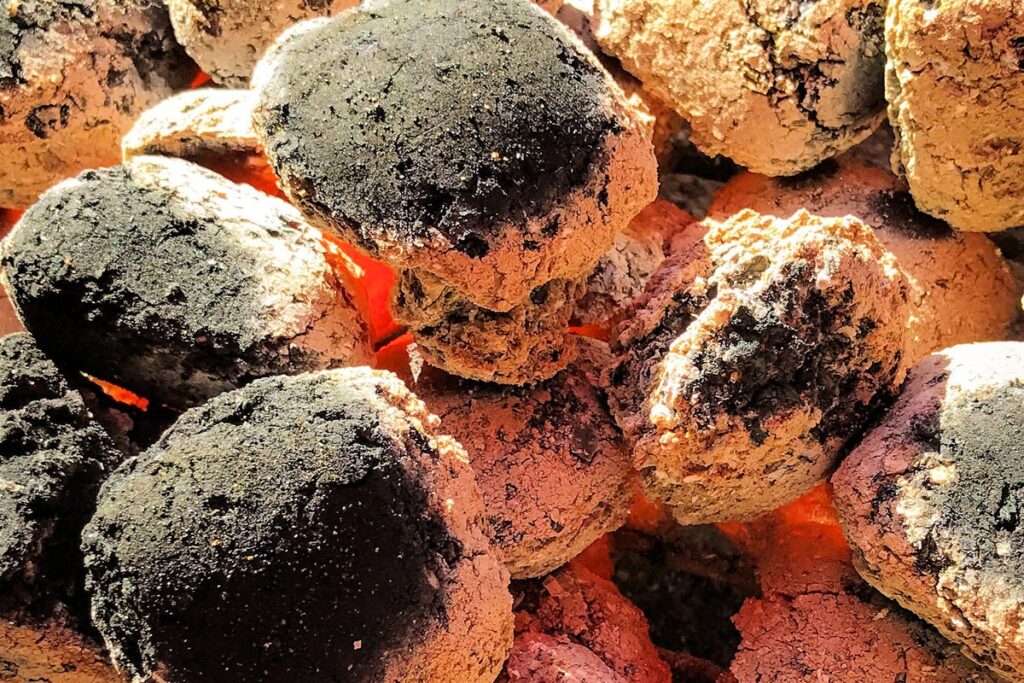
- Wait for the ash coating. Grey edges are the signal that the fuel is ready. Cooking over black briquettes gives you smoke and soot instead of heat.
- Build a two-zone fire. Tip the lit briquettes to one side so you have a hot zone for searing and a cool zone for finishing indirectly.
- Control heat with vents, not fuel. Open both vents to light, then close the bottom vent by two-thirds once you reach target temperature. The bottom vent sets oxygen, the top vent sets draft.
- Shut down to reuse. Closing both vents starves the fire, and the unburnt briquettes can be used again next time.
A chimney holds roughly 1.5 to 2 kg, which is enough for a standard kettle grill serving four to six people.
Choosing Grill Briquettes for Smoking and Low-and-Slow Cooking
For smoking, the requirement changes from peak heat to stability. A brisket at 110 to 135°C for twelve hours punishes any fuel that swings in temperature, which is why competition pitmasters moved toward dense, uniform briquettes.
Two techniques make grill briquettes work over long sessions:
- Snake method: arrange unlit briquettes in a curve around the edge of the fire basket, light one end and let the fire crawl slowly around the ring.
- Minion method: pour a chimney of lit briquettes on top of a full basket of unlit fuel. The unlit fuel ignites gradually from above, giving six to ten hours from one charge.
Either way, add two or three fist-sized wood chunks for grilling on top of the lit coal before the food goes on. The briquettes supply heat; the wood supplies the smoke profile.
If you are still deciding which cooker to buy, our breakdown of every BBQ grill with a smoker type explains how fuel use differs between offset, kamado and bullet designs.
Grill Briquettes for Shisha and Hookah Use
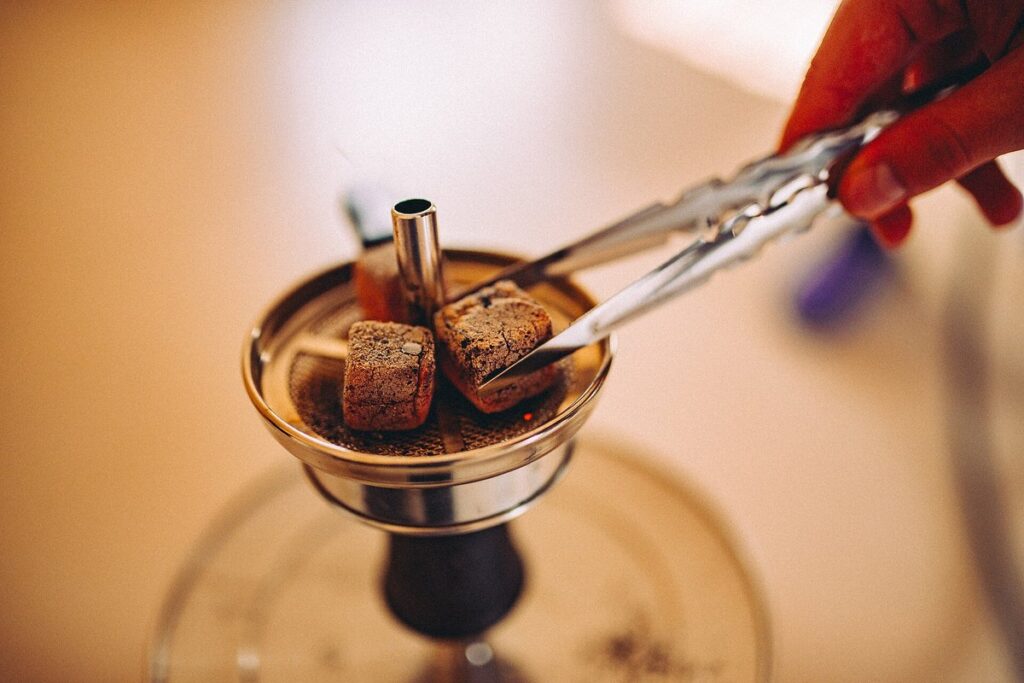
The same production line supplies shisha grade, but the specification is tighter. Hookah cubes are cut to 22x22x22 mm, 25x25x25 mm, 26x26x26 mm or 27x27x27 mm and burn 60 to 90 minutes each.
What lounge operators actually check is consistency: cube-to-cube size tolerance, ash that stays white to light grey, and the absence of sparks, odour or bitter taste. A cube that sparks on the bowl is a burn risk, and one that smells of accelerant ruins the session regardless of the tobacco.
Our shisha specification is 100% chemical and binder free with no nitrate accelerants, no recycled coal dust and no sulphur. Full details are on the {L(‘shisha-charcoal-briquettes-supplier’,’shisha charcoal briquettes supplier’)} page.
Buying Grill Briquettes in Bulk: MOQ, Packaging and Shipping
For importers, distributors and private label brands, the commercial terms matter as much as the burn.
- MOQ: one 20ft FCL container, approximately 14 to 15 tonnes depending on packaging.
- Packaging: 1 kg inner box with plastic lining plus 10 kg or 20 kg master carton, bulk PP mesh or woven bags, or custom private label and OEM artwork.
- Ports: FOB Tanjung Priok (Jakarta) or Talang Duku (Jambi).
- Documentation: MSDS, Self-Heating Test (SHT) and Certificate of Analysis (COA) on request, plus the standard export document set.
- Samples: available on request to test burn performance, ash and preparation time before committing to a container.
We are a direct producer, not a trading house, which means the specification on the COA is the specification in the bag. Read the full technical sheet on the coconut charcoal briquettes page, or see our charcoal briquettes supplier profile for certification and lead times.
Frequently Asked Questions
What are grill briquettes made of?
Most grill briquettes are made from carbonised biomass pressed into a uniform shape. Coconut shell grill briquettes are pressed from 100% coconut shell charcoal with no added coal dust, nitrate accelerants or chemical binders, giving a cleaner burn and far less ash than wood-based briquettes.
Are grill briquettes better than lump charcoal?
For long, temperature-sensitive cooks, yes. Grill briquettes are extruded to a consistent density, so they hold a steady temperature for hours, produce max 1.8-2.5% ash and need far less refuelling. Lump charcoal still wins for very fast, high-heat sears because it lights and peaks quicker.
How long do grill briquettes burn?
BBQ-grade coconut shell briquettes burn for up to 2.5 to 3+ hours per load at grilling temperature, and hold a low temperature for many hours in a smoker using the snake or minion method. Shisha-grade cubes typically burn 60 to 90 minutes each.
How many grill briquettes do I need for a BBQ?
A chimney starter holds roughly 1.5 to 2 kg, which is enough for a standard kettle grill serving four to six people. A full-size offset smoker needs around 4 to 5 kg for a long cook.
Can I buy grill briquettes in bulk for export?
Yes. Our standard export minimum is one 20ft container, approximately 14 to 15 tonnes depending on packaging, shipped FOB Tanjung Priok or Talang Duku with MSDS, SHT and COA documentation available on request.
Related Charcoal & Grilling Guides
- Lump Charcoal for Grilling
- Wood Chunks for Grilling
- BBQ Grill With a Smoker
- Best Gas Grills 2026
- Blues Hog Charcoal
- Coconut Charcoal Briquettes
- Shisha Charcoal Briquettes Supplier
- Charcoal Briquettes Supplier in Indonesia
- Coconut Shell Charcoal for BBQ
Product: Coconut Charcoal Briquettes — Export Grade for BBQ, Grill & Shisha